The Copenhagen plank: the groin exercise footballers love to hate
One exercise, under five minutes, and a trial in which it cut groin problems by 41%. It also hurts in a way that makes grown footballers question their life choices.
The Copenhagen plank is a side plank with your top leg resting on a bench or a partner's hands, so the inner thigh (adductor) muscles hold you up. In a trial with 652 semi-professional footballers, a programme built on it lowered the risk of groin problems by 41%. Start with the easier bent-knee version, build up slowly, and stop if it causes sharp groin pain.
Nursing one of your own? InjuryLog logs your pain each day and gives you an estimated return window. Get the app
Every football dressing room has one exercise that gets a groan when the strength coach announces it. In a lot of them, it’s this one.
The Copenhagen plank looks harmless. It’s a side plank with your top leg up on a bench. Then you try it, and about eight seconds in, the inside of your top thigh starts filing a formal complaint. That’s the point. It’s one of the few injury prevention exercises with genuinely good evidence behind it, and it takes less time than the warm-up chat about who was out on Saturday.
Why groins are worth protecting
Groin problems are a regular feature of football, and they have a habit of lingering. They’re rarely dramatic. More often it’s a tightness that comes and goes, then one day you go to kick a ball and it’s very much there. Our groin strain guide covers the acute pulls, and the athletic pubalgia guide covers the longer-running kind.
The adductors, the muscles on the inside of the thigh, are usually at the centre of it. Kicking, sprinting, changing direction and sliding into tackles all ask a lot of them, often when they’re stretched. Strong adductors cope better with that, which is where the Copenhagen comes in.
What the research found
In 2019, a group in Norway ran a trial with 35 semi-professional football teams, 652 players in total. Half the teams added one exercise to their training, the Copenhagen adduction, in three levels of difficulty. They did it three times a week during the six to eight week preseason, then once a week through the 28-week season. The other teams trained as normal.
Over the season:
- groin problems affected 13.5% of players at any given time in the Copenhagen group, against 21.3% in the normal-training group
- that worked out as a 41% lower risk of groin problems for the players doing the programme
- most players needed under five minutes a session
The catch came afterwards. When the same researchers surveyed the players, only about 46% said they had done the programme as recommended, and only 31% planned to keep doing it properly the following season. So the exercise works. The hard part is getting footballers to keep doing something that’s boring and a bit sore. Which, to be fair, is also the history of rehab.
How to do it
You need a bench, a low box or a patient teammate. These are the common ways to make it easier or harder; the trial used its own three-step version on the same idea. Start with the easiest, even if your ego has other plans.
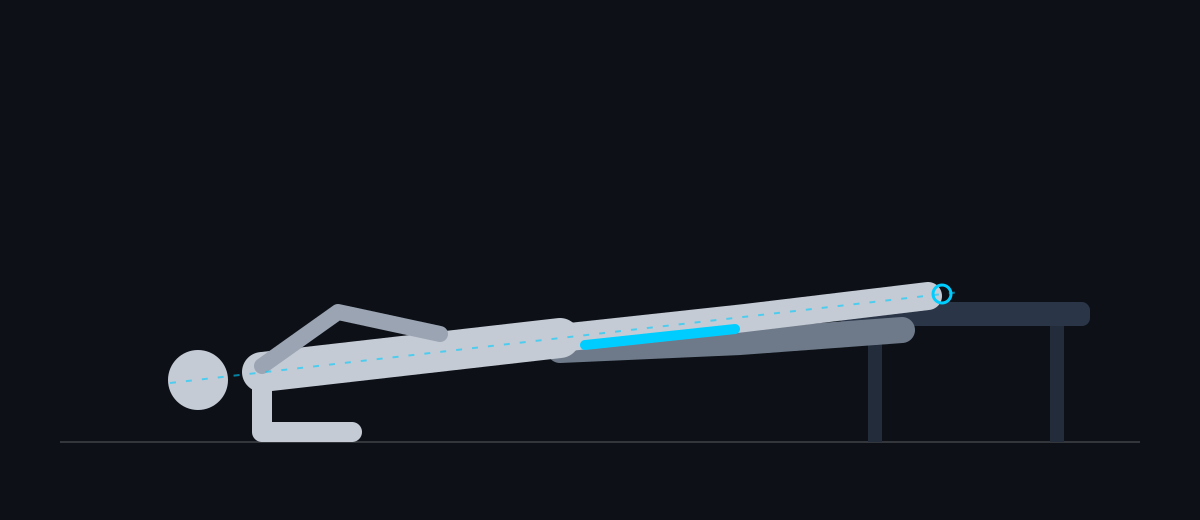
Level 1: the short lever. Lie on your side with your top knee resting on the bench, knee bent, and your bottom leg underneath. Prop yourself up on your forearm, elbow under your shoulder. Lift your hips until your body is in a straight line from shoulder to knee, hold briefly or lower slowly, and repeat. The top leg is doing the work by pressing down into the bench.
Level 2: the long lever. Same setup, but with the top leg straight and the inside of your ankle or lower shin on the bench instead of your knee. A longer lever means far more load on the adductors. This is the version most people mean when they say “Copenhagen plank”.
Level 3: long lever with the bottom leg moving. From the long lever position, bring the bottom leg up to meet the bench, then lower it again, keeping your hips up throughout. This is the one that ends conversations.
A few rules that save groins:
- Build up slowly. Start with a small number of slow reps or short holds each side and add a little each week. The trial spread its progression across the whole preseason for a reason.
- Keep it controlled. Hips up, body straight, no sagging or twisting. If your hips are dropping, go back a level.
- Expect effort, not pain. A strong burning in the inner thigh is normal. Sharp pain in the groin, or pain that’s worse the next day, means stop and go back a level, or get it assessed.
- Keep the once a week going in season. It’s the dull bit that keeps the protection.
If you’re already injured
The Copenhagen plank is prevention, and later, a part of rehab once a groin has settled. It is not a test of whether your groin is better. If it’s sore now, the order is: get it assessed, let the early stage settle, rebuild strength gradually, then the harder versions. The recovery time estimator gives typical ranges for groin strains by grade, and the return to sport calculator covers the checks before you’re properly back.
And if your hip flexor is the actual culprit, which happens more than people think, the hip flexor strain guide will save you some confusion.
The good news: five minutes, a bench and a bit of suffering. As preventive medicine goes, it’s a bargain.
Keep the whole injury in one place.
InjuryLog puts the injury on a body map, takes a 20-second check-in each day, keeps your scans and physio notes against it, and gives you an estimated return window. On iOS and Android. Educational, not medical advice.
The questions people ask
What muscles does the Copenhagen plank work?
Mainly the adductors, the muscles on the inside of the thigh that pull your leg in towards the middle. They're the muscles most often involved in groin strains in football. The plank also works the side of your trunk and the hip of the bottom leg.
How often should you do the Copenhagen plank?
In the trial behind it, players did the programme three times a week during a six to eight week preseason, then once a week through the season. It took most of them under five minutes a session. The once-a-week in-season dose is the part people drop, and it's the part that keeps the benefit going.
Can I do the Copenhagen plank with a groin strain?
Not as a first step. If you have groin pain right now, get it assessed and follow a rehab plan, which may bring adductor strengthening back in gradually once the pain allows. Doing a hard version on an injured groin to test it is a reliable way to make it worse.
Is the Copenhagen plank only for footballers?
No. The research was done in football, but adductor strength matters in any sport with kicking, sprinting, skating or quick changes of direction: GAA, hurling, rugby, hockey and ice hockey included.
Sources
- The Adductor Strengthening Programme prevents groin problems among male football players: a cluster-randomised controlled trial (Harøy et al., 2019), British Journal of Sports Medicine
- Implementation of the Adductor Strengthening Programme: players primed for adoption but reluctant to maintain (Harøy et al., 2019), Scandinavian Journal of Medicine & Science in Sports, via PubMed Central
- Sprains and strains, NHS